Continuing Education

Get Cardiology related Articles, Journals, Videos and more details at Radcliffe Cardiology site.

Online Cardiovascular Disease

Go to read Online Cardiovascular Disease relarted articles via atrial fibrillation association afa.

Cardiology Mayo Clinic

Cardiology Mayo Clinic provides informative info about cardiology at RC site.

Cardiovascular Research Foundation

Free and register PDF and journales available at here!!!

Cardiology Video

Arrange seminar and online video conference by expert cardiologist, Visit at site.

Showing posts with label Fractional Flow Reserve Measurement. Show all posts

Tuesday, 27 January 2015

Fractional Flow Reserve Measurement For Assessing Coronary Stenosis

Coronary Heart Disease which occurs as a result of atherosclerotic plaque-build up in the inner walls of coronary arteries is a common heart ailment that has been affecting millions of people worldwide. The field of cardiac science and interventional cardiology has been striving hard to devise an optimal approach to manage coronary artery disease (CAD).  Evaluating the physiological significance and severity of lesions is a challenging factor in most cases which is why pressure-based Fractional Flow Reserve measurement method was introduced. FFR provides a well-validated index in deciding between coronary stenting and medical therapy. Thses days, it is considered an indispensable clinical tool in the catheterization laboratory.

Pressure-based Fractional Flow reserve measurement provides the ratio of normal blood flow to the maximum achievable blood flow in the same coronary artery, given the maximal vasodilated condition. Lesions that measure a FFR value of less than 0.75 need percutaneous coronary intervention (PCI) with stenting, while lesions of a value higher than 0.75 should be managed with pharmacological treatment. Minimally invasive FFR technique possesses several special features that make it a gold standard for diagnosis in the catheterization laboratory. A well-defined cut-off value, unequivocally normal value for every patient and narrow gray zone are some of the major characteristics. Fluoroscopy guided pullback pressure recording performed during the catheterization proves to be a great tool in obtaining detailed spatial information and evaluating the hemodynamic effect of stenoses. The sensor placed in the distal coronary artery during FFR procedure is simply pulled back under fluoroscopic guidance to measure the pressure levels across the blood vessel. Helping the interventional cardiologist to assess the extent of lesions and exact location of the pressure drop, fluoroscopy guided pullback pressure recording proves to be a great diagnostic tool for different patient subsets.

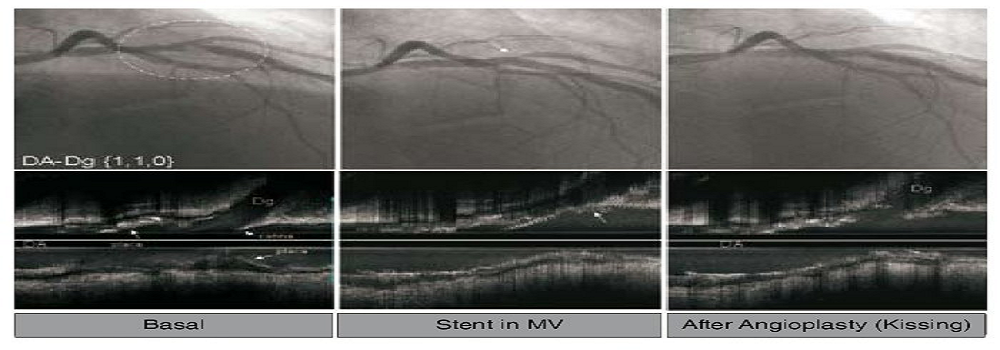
Bifurcation lesions that involve the proximal main vessel, the distal main vessel and the side branch are one of the most challenging lesion subsets. Associated with restenosis, greater complications and lower success rates, severe coronary artery bifurcation lesions pose a major challenge for the interventional cardiologists. PCI is not considered as a favourable approach to treat the symptomatic coronary artery bifurcation lesions. However, with the advent of fractional flow reserve method and pullback pressure measurements, FFR guided PCI assures excellent results and safer outcomes.
Monday, 10 November 2014

Fractional Flow Reserve Measurement and Optical Coherence Tomography in Guiding Coronary Interventions

Blockage of oxygen-rich blood supply to the heart due to the plaque build-up in coronary arteries is the primary cause for heart attacks. Termed as Coronary Artery Disease (CAD), this heart problem occurs due to a condition called atherosclerosis.  In some cases, plaque build-up is not just limited within a single epicardial vessel but to multiple vessels known as Multi vessel CAD or coronary multivessel disease. If defined in medical terms - "a condition where 70% or greater stenosis is affected in at least one major epicardial vessel and 50% or greater stenosis is affected in at least other major vessels".

Though coronary angiography has been considered as the ‘gold standard’ for diagnosing ischemic heart conditions, it has many limitations. It often failed in providing comprehensive and accurate information about the physiological significance of lesions. That is when the well-validated Fractional Flow Reserve measurement came into the limelight. Performed along with the cardiac angiogram, it has been proved as a safe and reliable diagnostic tool to differentiate between ischemic and non-ischemic stenosis.

Optical Coherence Tomography (OCT)

On the other hand, medical imaging techniques such as Intra Vascular Ultra Sound (IVUS) and Optical Coherence Tomography (OCT) have found a place in interventional cardiology. Functional severity of stenosis, plaque morphology and intraluminal coronary dimensions are some of the many features that can be assessed with IVUS.  Whereas, OCT is slightly more efficient than the IVUS technique as it offers microscopic visualization of ten-times higher resolution. Advanced Optical Coherence Tomography technique renders clear and detailed pathophysiology of atherosclerotic plaque. 

In terms of treatment choices for multivessel diseases, we presently have surgical management and medical therapy. Revascularization methods include Percutaneous Coronary Intervention (PCI) or angioplasty and Coronary Artery Bypass Graft (CABG) or bypass surgery. Reliable Fractional Flow Reserve Measurement value along with angiographic data helps physicians decide between PCI and medical therapy for single vessel CAD. Negating the need of repeated revascularization and relieving the likelihood of angina to a greater extent, CABG appears to be a superior choice over PCI when it is concerns treating multivessel disease. However, with the advancements in catheterization, medical imaging and stenting techniques, physicians are shifting away from the aggressive bypass surgical procedures and opting for less-invasive percutaneous treatments that ensure favourable long-term outcome. Yet, the optical treatment strategy for multi vessel CAD remains a controversial topic.