Continuing Education

Get Cardiology related Articles, Journals, Videos and more details at Radcliffe Cardiology site.

Online Cardiovascular Disease

Go to read Online Cardiovascular Disease relarted articles via atrial fibrillation association afa.

Cardiology Mayo Clinic

Cardiology Mayo Clinic provides informative info about cardiology at RC site.

Cardiovascular Research Foundation

Free and register PDF and journales available at here!!!

Cardiology Video

Arrange seminar and online video conference by expert cardiologist, Visit at site.

Showing posts with label Fractional Flow Reserve (Ffr). Show all posts

Wednesday, 26 November 2014

Why FFR-Guided Revascularization Strategy Is More Effective?

Coronary Artery Disease (CAD) or Coronary Heart disease is a serious heart condition that occurs as a result of atherosclerosis. Hardening or narrowing of the artery (stenosis) causes an obstruction in the blood flow to the heart which may lead to major cardiovascular events. When the heart muscle is starved of oxygen, it results in acute chest pain and discomfort (angina) whereas heart attack (myocardial infarction) is the outcome of a completely blocked blood flow through a coronary artery. Hence, it is important to diagnose and treat coronary heart disease as early as possible, as time plays a crucial role here. Plaque build-ups along the inner walls of blood vessels can cause blockage in either single or multiple coronary arteries. Multi vessel disease (MVD) or Multi vessel CAD is the condition where a major epicardial vessel is affected with 70% or greater stenosis and other major vessels are affected with 50% or greater stenosis.  
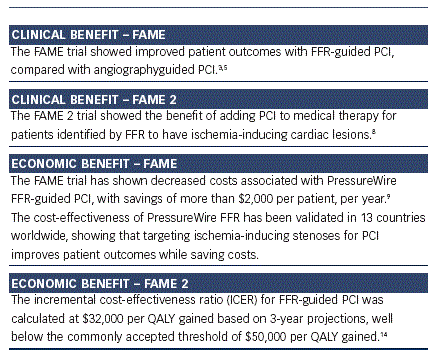
Clinical And Economic Benefits Of FFR As Revealed In FAME And FAME 2
Medical therapy, Percutaneous Coronary Intervention (angioplasty and stenting) and Coronary Artery Bypass Grafting (CABG) are the treatment options available for coronary heart disease. Interventional cardiologists used to rely on angiography results and other clinical information to detect the evidence of inducible ischemia and guide treatment decisions. Notwithstanding coronary angiography is considered as the gold standard for CAD evaluation, it has been recognised to have several limitations in assessing the functional significance of coronary lesions. In the case of multi vessel coronary disease, the decision-making is far more challenging as angiographic data tend to either overestimate or underestimate the functional severity of stenosis. Revascularization of non-ischemic lesions not only increases the treatment costs but also poses an increased risk for the CAD patient rather than offering any benefit. That is when the results published by the FAME (Fractional Flow Flow Reserve versus Angiography in Multivessel Evaluation) study gained substantial interest in the medical community. It demonstrated that FFR-guided PCI can ensure better outcomes when compared to the angiography-guided PCI.

Fractional Flow Reserve (FFR) measurements can be taken easily during the invasive procedure just before the stenting. A 0.75 cut-off value helps in differentiating between ischemic and non ischemic stenosis. Lesions with a FFR value of less than 0.75 needs drug-eluting stents (DES) while lesions with a FFR value greater than 0.80 should be treated with medical therapy. The FAME study results proved that routine measurements of FFR during PCI significantly reduced the occurrence of myocardial infarction (MI), combined end point of death and repeat revascularization. So it can be hypothesised that FFR measurements are helpful in guiding decisions regarding whether CABG, stenting or medical therapy would be the optimal approach for each CAD patient.
Monday, 6 October 2014

Cardiology Conferences aim to educate professionals

Cardiovascular disease is the world’s biggest killer. An estimated 17.3 million people died from CVDs in 2008 and this is believed to increase to more than 23 million people in 2030. Controlling these numbers is thus a major challenge and why major institutions and universities around the globe are working tirelessly to find new treatments. They organize cardiology conferences for professionals to share and discuss innovations in the field and provide delegates with information about recent research so that they can learn new ways of treating heart patients. In the world cardiology conferences, renowned speakers and reputed authorities gather to share findings and trial results to help medical practitioners learn about new innovations in cardiology.

Fractional Flow Reserve (Ffr)

Thousands of health-providers participate in these international seminars and receive new insights from cardiology journals and articles. Experts on Embolic Protection share their views and explore how heart surgeons can use carotid angioplasty in patients to save many lives. Embolic Protection devices are used to remove debris from cardiovascular disease patients. These seminars provide wide and deep knowledge about the latest treatment through papers written by researchers and experts. 

Above all, medical information centers work incessantly in innovating new and easy ways of treatment so that expenses and the surgery time can be reduced. There are many recognized experts who published their articles and papers on Fractional Flow Reserve (FFR). They spend years in research to find the Fractional Flow Reserve (FFR) technique for measuring the pressure difference in coronary catheterization. Some practitioners are slow to learn about advances in mediacal treatments for heart patients and they continue applying traditional techniques. In these cases, research papers, journals and provide them a thorough knowledge about recent treatments. 

Wednesday, 13 August 2014

The importance of Fractional Flow Reserve (FFR) in Coronary Artery Disease Management

Patients with insufficient oxygen supply to the heart, or myocardial ischemia, may benefit from coronary intervention (PCI), such as stenting of partially occluded vessels. The course of treatment for patients with CAD depends on disease severity. While coronary angiography is always performed prior to PCI, it may underestimate or overestimate the severity of specific cardiac lesions. In contrast, Fractional Flow Reserve (FFR) provides a quantitative ratio of the actual blood flow in a narrowed artery, compared with the normal achievable blood flow and is more accurate in diagnosing ischemic lesions than angiography alone. Using this functional or morphological measurement, Fractional Flow Reserve (FFR) can quantify the severity of specific stenoses.

A 2012 report prepared by multiple cardiology medical societies addressed the use of FFR in appropriate use criteria for diagnostic cardiac catheterization. These appropriate use criteria recommend FFR for diagnostic evaluation of most CAD cases determined by angiography to be of intermediate, obstructive/significant or indeterminate severity. Further targeted appropriate use criteria update for coronary revascularization were launched in the same year by various societies including the ACCF, SCAI, STS, AATS, AHA, ASNC, HFSA and SCCT. Within the criteria, the use of diagnostic cardiac catheterization is recommended as an additional invasive measurement to determine the need for PCI for patients with coronary narrowing of uncertain severity.

The critical role of physiological fractional flow reserve (FFR), in guiding interventions is discussed at a number of cardiology conferences. One such cardiology conference is the European Society of Cardiology (ESC) 2014 which takes place in Barcelona this year. The ESC hosts the world’s largest and most influential cardiovascular event every year in August. Record numbers of hot line sessions and abstracts were submitted this year and the congress is on track to host the largest number of delegates in its history.